


When your energy, focus, sleep, and recovery start to feel different, it is easy to wonder whether stress, hormones, or aging are catching up with you. That is where NAD+ benefits for women become more crucial. NAD+ helps power the cellular energy and repair systems your body relies on as hormones shift, stress builds, and recovery takes longer.
NAD+ is a coenzyme your cells use to stay energized and function well over time. It is not a magic fix, but supporting NAD+ may help your body handle perimenopause, menopause, daily stress, and healthy aging with more stability.
In this guide, we’ll explain how NAD affects women’s health and how supplementation can boost your health. We’ll also discuss what you can expect from NAD as you age and how it can support your health with the help of IV Concierge.
What is NAD+ and why does it matter specifically for women?

NAD+ stands for nicotinamide adenine dinucleotide. It’s a coenzyme your body produces naturally and uses in nearly every cell to generate energy and repair damage.
Without adequate NAD+, cellular energy production slows, DNA repair becomes less efficient, and the biological processes that keep your body functioning well begin to decline.
This matters because NAD+ decline in women is steeper and begins earlier than in men, as research published in PubMed Central confirms. Estrogen is a significant reason why.
Estrogen helps regulate how your body produces and recycles NAD+. As estrogen drops — whether gradually through your 30s and 40s or more sharply during perimenopause — NAD+ production drops with it.
An enzyme called PARP matters here too. PARP (poly ADP-ribose polymerase) consumes NAD+ rapidly during cellular stress and DNA damage. Also, women’s hormonal fluctuations trigger more PARP activity, which accelerates depletion compared to men of the same age.
How NAD+ works inside your cells
NAD+ powers mitochondrial function in women — working with mitochondria, the structures responsible for converting nutrients into usable energy.
It also activates proteins called sirtuins; this sirtuin activation regulates DNA repair, inflammation, and cellular aging. When NAD+ is sufficient, that protection is active. When NAD+ declines, it diminishes.
Why women experience a faster and earlier NAD+ decline
NAD+ decline in women is steeper and begins earlier than in men. Levels drop gradually through the late 20s and accelerate from around 35 onward.
By perimenopause, NAD+ may be less than half of what it was at 20. That decline shows up as persistent fatigue, slower physical recovery, and reduced cognitive sharpness. Current research is clarifying how restoring NAD+ levels may address some of these effects directly.
The top 10 NAD+ benefits for women
The top NAD+ benefits for women begin at the cellular level. Here are some of the benefits that our clients enjoy and keep them coming back for NAD IV Therapy:
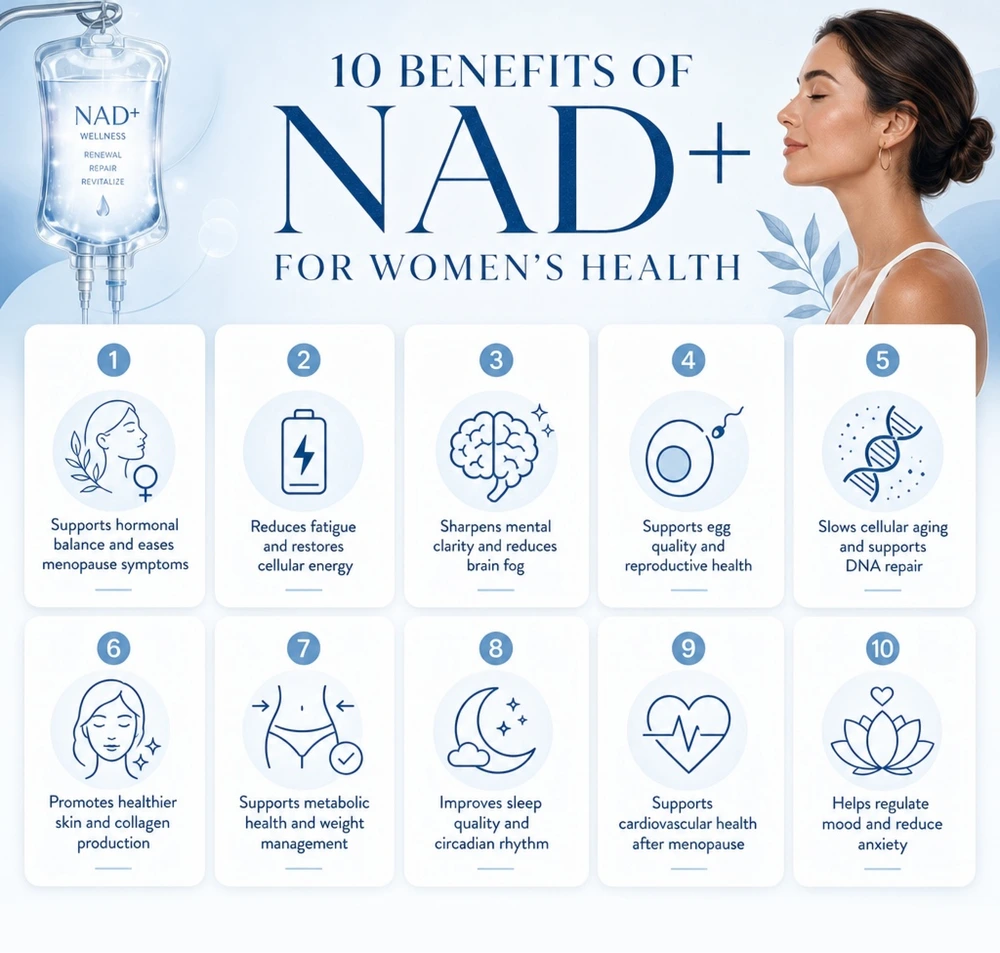
1. Supports hormonal balance and eases menopause symptoms
The NAD+ estrogen connection works in both directions. When NAD+ drops, the cellular processes that regulate hormonal signaling become less efficient. This can intensify symptoms that accompany fluctuating estrogen — hot flashes, mood changes, irregular cycles, and disrupted sleep.
A 2021 review found that sirtuin activation, which depends on NAD+, plays a direct role in regulating key hormonal pathways. NAD+ support does not replace hormone therapy, but it helps your cells respond to hormonal changes more efficiently.
Think of it as addressing the cellular environment in which your hormones have to operate.
2. Reduces fatigue and restores cellular energy
When women seek NAD+ energy support, persistent fatigue that sleep does not resolve is almost always the reason. It’s often rooted in mitochondrial dysfunction — cells that are not converting nutrients into energy effectively.
NAD+ is the essential ingredient in that conversion. A randomized clinical trial in npj Aging found that NMN supplementation significantly improved energy metabolism in older adults within a few weeks.
For women managing work, family, and their own health at the same time, restoring NAD has a measurable impact on daily stamina and endurance.
3. Sharpens mental clarity and reduces brain fog
Brain fog is common during perimenopause and is often related to reduced energy supply in the brain. Your brain is one of your most metabolically demanding organs, requiring consistent energy production to sustain focus and recall.
NAD+ supports mitochondrial function in neurons and activates sirtuins that protect brain cells from oxidative stress. A 2022 research links NAD+ depletion to cognitive decline and documents its neuroprotective effects.
4. Supports egg quality and reproductive health
NAD+ plays an important role in egg quality and mitochondrial health inside reproductive cells. Eggs need a steady supply of energy to mature, divide, and function properly. As mitochondrial efficiency naturally declines with age, fertility and reproductive outcomes can be affected.
A University of New South Wales study published in Cell found that restoring NAD+ levels improved egg quality and fertility outcomes in older mice. Human research is still developing, but fertility specialists are paying closer attention to how NAD+ may support reproductive health.
5. Slows cellular aging and supports DNA repair
Your DNA deals with daily stress from sun exposure, normal metabolism, and environmental factors. NAD+ supports this repair process because PARP enzymes need it to help fix DNA damage. It also helps activate sirtuins, which support telomeres, the protective ends of chromosomes tied to cellular aging.
A 2016 study in Science found that raising NAD+ levels reversed certain aging markers in muscle tissue. For women, this may matter for skin health, brain function, and metabolism. This is one reason NAD+ research has become such a major focus in longevity medicine.
6. Promotes healthier skin and collagen production
Collagen production depends on steady cellular energy and repair, both of which rely on healthy NAD+ levels. This is one of the more visible NAD+ supplement benefits women may notice over time.
As NAD+ declines, skin can become thinner, elasticity may decrease, and cell turnover can slow down. NAD+ also supports sirtuin activation, which helps protect skin cells from UV damage and early aging.
A 2025 study in PubMed Central found that NAD+ precursors helped repair skin DNA and reduce photoaging markers. Topical products work on the surface, while NAD+ supports the cellular processes behind healthier-looking skin.
7. Supports metabolic health and weight management
Metabolism is about how well your cells turn nutrients into energy, not just how many calories you eat. NAD+ supports weight management by activating SIRT1, a sirtuin involved in insulin sensitivity, fat metabolism, and energy use.
When NAD+ levels decline, metabolic efficiency may decline too. This can help explain why weight management often feels harder in midlife, even when your diet and activity have not changed much.
A 2021 research found that NMN supplementation improved insulin sensitivity and energy metabolism in prediabetic women. Supporting NAD+ helps address cellular metabolism at the source.
8. Improves sleep quality and circadian rhythm
Your circadian clock is the internal system that helps regulate when you feel awake and when your body is ready for sleep. NAD+ plays a role in this process through SIRT1, a sirtuin connected to sleep-wake timing.
When NAD+ levels drop, circadian rhythm changes may show up as restless sleep, nighttime waking, or feeling tired even after a full night in bed.
A study in Frontiers in Physiology identified NAD+ as an important regulator of circadian rhythm. At IV Concierge, better sleep quality is one of the common changes clients ask about when starting NAD+ support.
9. Supports cardiovascular health after menopause
Before menopause, estrogen helps support cardiovascular health. As estrogen declines, that protection decreases, and heart disease risk can rise.
NAD+ may support the heart by helping mitochondria work efficiently in heart muscle cells and by supporting healthier blood vessel function. It also activates sirtuins, which help regulate inflammation and oxidative stress.
According to the American Heart Association Journals, NAD+ is an important part of cardiovascular repair and vascular function. After menopause, heart health is not only about cholesterol. Cellular energy, inflammation, and blood vessel health also matter.
10.Helps regulate mood and reduce anxiety
NAD+ may support mood by helping brain cells produce energy, manage inflammation, and stay more resilient under stress. Low cellular energy and ongoing neuroinflammation are both linked to anxiety and depression, which is why cellular health matters for mental wellness.
NAD+ also plays a role in the tryptophan pathway, which is connected to serotonin production. This does not make NAD+ a treatment for anxiety or depression, but supporting NAD+ may help the brain maintain steadier energy and stress response over time.
NAD+ and women’s hormonal health
The estrogen-NAD+ connection
Estrogen and NAD+ both support cellular energy, repair, and stress response. A key link is NAMPT, the enzyme that helps your body recycle NAD+.
When estrogen is steady, your mitochondrial function and cellular repair are better supported. When estrogen fluctuates or declines, these systems may feel less efficient. This is one reason perimenopause NAD+ decline can feel sudden for some women.
The estrogen-NAD+ connection also matters because PARP enzymes use NAD+ for DNA repair. During midlife, you may need more repair support while hormone changes make energy and recovery feel less steady. That is why NAD+ and menopause hormones are closely connected in women’s health.
NAD+ during perimenopause and menopause
Perimenopause NAD+ decline can begin years before your menstrual cycle stops. During this stage, estrogen rises and falls unevenly, which can affect sleep, energy, mood, temperature regulation, and mental clarity.
Many of these symptoms overlap with what we see when NAD+ levels decline. That does not mean NAD+ is the only cause, but it does show why cellular energy and hormone changes are closely connected during midlife.
Supporting NAD+ during perimenopause does not replace hormone therapy or care from your OB-GYN. It may help give your body better cellular support while you manage the transition with the right medical plan in place.
Can NAD+ help with PCOS or thyroid function?
NAD+ may be relevant for PCOS because insulin resistance is a common part of the condition. Early NAD+ and PCOS research is looking at how NAD+ supports insulin sensitivity through SIRT1 activation. This does not make NAD+ a PCOS treatment, but it may support the cellular pathways involved in metabolic health.
The connection between NAD+ thyroid function is more indirect. Thyroid hormones help regulate your metabolic rate, while mitochondria help your cells respond to those signals. NAD+ may support the cellular environment where thyroid signaling happens.
The evidence is still early, so this is not something to manage on your own. If you have PCOS, hypothyroidism, Hashimoto’s, or other hormone concerns, talk with your OB-GYN or endocrinologist before starting NAD+ support.
NAD+ for women by life stage

Women in their 30s: fertility, energy, and prevention
For women in their 30s, NAD+ and fertility may become a bigger focus because NAD+ supports mitochondrial health in eggs. This matters more as you move through the decade.
NAD+ decline is usually gradual during these years, but you may start noticing slower recovery, lower energy, or focus that takes more effort.
Your 30s are a good time to build a stronger foundation with better sleep, steady nutrition, stress support, and targeted options like supplementation or IV therapy when appropriate.
Women in their 40s: perimenopause and the decline curve
For women in their 40s, NAD+ and perimenopause often become connected because NAD+ levels may decline as estrogen starts to fluctuate. When both systems shift at the same time, you may notice changes in energy, mental clarity, sleep, and body composition more quickly than expected.
This is also when many of our clients start asking more specific questions about NAD+ in women over 40. The changes you are feeling are not random. They are often tied to real biological shifts, and with the right plan, there may be practical ways to support your body through them.
Women in their 50s and beyond: Menopause, longevity, and vitality
After menopause, women often face their most significant NAD+ decline. Women over 50 dealing with NAD+ and aging face substantially lower NAD+ levels, slowed mitochondrial function in key tissues, and elevated cardiovascular and cognitive risks.
Longevity research on NAD+ in women over 50 is particularly relevant at this stage — work from Harvard’s David Sinclair consistently identifies NAD+ restoration as one of the most evidence-supported strategies for reversing cellular aging markers.
Women in their 50s and 60s who support NAD+ levels often recover energy and mental sharpness that they had attributed to permanent age-related change. Those changes are not guaranteed, but they are tied to cellular pathways that continue to be studied in longevity medicine.
NAD+ and physical performance for women
Preserving muscle mass and strength after 40
The connection between NAD+ and sarcopenia after menopause matters because muscle loss can speed up when NAD+ and estrogen decline together. Muscle tissue needs strong mitochondrial function to perform, recover, and stay strong.
NAD+ supports mitochondrial function in muscle cells and helps activate sirtuins involved in muscle repair and protein synthesis. A study in Cell Metabolism found that NAD+ precursor supplementation improved muscle function and physical performance in older adults.
For women working to maintain strength, this is about more than exercise. It’s about supporting the cellular systems that help muscles respond and recover.
Exercise recovery and VO2 decline in women
NAD+ also supports exercise efficiency and recovery. NAD+ and VO2 max in women matters because oxygen capacity tends to decline with age and may drop more noticeably after menopause.
NAD+ helps with oxidative phosphorylation, the process your cells use to turn oxygen into energy. When this works well, your body can use oxygen more efficiently and recover more smoothly after activity.
In practice, NAD+ exercise recovery for women is one of the improvements our active clients often ask about. For women over 40, NAD+ and physical performance come down to better cellular energy, recovery, and support for staying active.
NMN vs NR: which NAD+ precursor is better for women?
Oral NAD+ support usually works through precursor molecules that your body can convert into NAD+ inside cells. For women, the main NAD+ precursor comparison comes down to two options: NMN, or nicotinamide mononucleotide, and NR, or nicotinamide riboside.
Here’s a quick comparison table to help you see the difference between NMN and NR supplements:
| Feature / Aspect | NMN (Nicotinamide Mononucleotide) | NR (Nicotinamide Riboside) |
| Position in NAD+ pathway | One step from NAD+ in the biosynthesis pathway | Two‑step conversion to NAD+ |
| Bioavailability | High, especially with liposomal delivery | Good, well‑studied in humans |
| Cost per dose | Higher | Moderate |
| Research depth | Growing rapidly; strong animal and early human data | More established human trial record |
| Best for | Metabolic health, energy, fertility support | Cognitive function, general NAD+ maintenance |
How to take NAD+: supplements vs. IV therapy
Oral supplements — NMN and NR: what to expect
Oral NAD+ support is one part of the NAD+ supplements vs IV therapy decision many women face. NMN and NR supplements are usually the easiest starting points because they are widely available and simple to take consistently.
Quality matters most. Look for third-party tested products, clear labeling, and formulas without unnecessary additives. Oral effectiveness can vary because some of the precursor is broken down during digestion before your body converts it into NAD+.
For oral NAD+ supplement dosage, clinical trials often use 250–500 mg of NMN or NR daily. Many women notice changes in energy or sleep within 2–4 weeks, while steadier results may take 2–3 months.
IV NAD+ therapy: is it worth it for women?
NAD+ IV therapy for women delivers NAD+ support directly into the bloodstream, which bypasses the digestive system. This is why some clients notice results faster than they do with oral supplements.
IV therapy may be helpful if you want a more targeted approach or if you’re not responding well to oral supplements. It’s also a better choice if you’re moving through perimenopause, menopause, prolonged stress, illness recovery, or burnout.
NAD IV sessions usually take 1–4 hours depending on the dose and formulation. Some clients use NAD+ IV therapy as periodic maintenance, while others schedule it during more demanding health or lifestyle periods.
If you prefer a faster way to take NAD, you can also consider NAD injections at IV Concierge.
👉 Ready to boost your NAD levels? Schedule your same-day IV therapy anywhere in Miami!

NAD dosage guidelines for women
NAD+ dosing for women depends on the delivery method, health history, goals, and tolerance. Clinical studies have used oral doses ranging from 250 mg to 1,000 mg daily, while IV dosing should be determined individually.
More is not always better. A qualified provider should review your history, medications, and goals before recommending a protocol. At IV Concierge, we do not use one-size-fits-all plans. We will conduct a consultation first before we administer your NAD treatment.
Is NAD+ safe for women?
General NAD safety profile
For most healthy adults, oral NAD+ precursors like NMN and NR appear to be well tolerated in short-term human studies. Still, research is stronger for general adult safety than for every women’s health situation.
Clinical trials have found NMN to be well tolerated at doses up to 900 mg daily, and another short-term study reported no severe adverse events at 1,250 mg daily. NR has also been studied in middle-aged and older adults with no serious adverse events reported in one small trial. Mild digestive discomfort, nausea, flushing, headache, or skin changes can still happen.
That positive NAD+ safety research for women does not mean every dose or delivery method is right for you. Your health history, medications, hormone status, and goals all matter.
NAD safety during pregnancy and breastfeeding
If you’re pregnant or breastfeeding, NAD+ support should be approached with caution. NAD+ safety during pregnancy is not well established in human studies, and the same is true for NAD+ use while breastfeeding.
Animal research is not enough to make a clear safety recommendation for pregnant or nursing women. If you’re pregnant, trying to conceive, or breastfeeding, talk with your OB-GYN before starting NAD+, NMN, NR, or any new supplement.
Interactions with hormonal medications and HRT
For women taking birth control or hormone therapy, NAD+ and HRT interactions appear to be low concern based on current evidence, but direct research is still limited. The same applies to NAD+ and oral contraceptive interactions.
If you take estrogen, progesterone, thyroid medication, fertility medication, or any prescription hormone therapy, disclose that during your consultation so we can review your health first.
How long does NAD work for women?
A common question we hear is, “How long does NAD+ take to work for women?” The honest answer is that your timeline depends on your baseline health, age, sleep, stress, hormones, and whether you choose oral supplements or IV therapy.
Here’s a realistic NAD+ results timeline based on clinical study timelines and what we commonly see in practice:
- Within 2 weeks: Some women notice better energy, less afternoon fatigue, and improved sleep quality after getting NAD treatments. This is often when clients start feeling less “wired but tired” at night. A clearer head and steadier mood may also show up during this early window.
- By 4–6 weeks: NAD+ effects often become more consistent. You may notice better mental clarity, improved exercise recovery, and more stable energy throughout the day. Women going through perimenopause may also notice that their body feels a little more supported during hormone-related shifts.
- At 2–3 months: This is often when to expect NAD+ benefits tied to metabolism, skin quality, and longer-term cellular support. Many NAD+ precursor studies use 8–12 week marks because meaningful cellular change usually takes consistent support over time.
IV therapy clients may notice energy or mental clarity changes sooner, sometimes within 24–48 hours. Long-term results still depend on consistency, your overall health plan, and choosing the right NAD+ approach for your body.
Get effective NAD IV therapy from IV Concierge
If you’re ready to explore NAD IV therapy with a team that takes safety seriously, IV Concierge can help. Our care is led by founders Natalie Gailis, RN, and Jonathan Rakofsky, MD, and backed by 20 years of medical experience.
Your treatment is RN administered, physician supervised, and made with pharmaceutical-grade ingredients every time for quality, consistency, and maximum potential benefits. A dedicated licensed nurse stays with you from start to finish, monitors your comfort, and answers your questions throughout the visit.
We make the process simple with mobile IV therapy across Miami – we come to your home, office, hotel, or preferred location.
Book a consultation with IV Concierge to discuss your goals and get a personalized NAD IV therapy plan!
Frequently asked questions about NAD+ for women
Does NAD+ help with menopause symptoms?
NAD+ may help support menopause symptoms related to energy, brain fog, sleep, and recovery, but it does not replace hormone therapy or medical care. During perimenopause and menopause, estrogen changes can affect mitochondrial function and cellular repair.
NAD+ support may help those systems work more efficiently, which is why some women notice better stamina, clearer thinking, and steadier recovery over time.
Can NAD+ improve egg quality and fertility?
NAD+ may support egg quality by helping mitochondria function inside reproductive cells. Eggs need strong cellular energy to mature and divide properly.
Animal research has found that NMN, an NAD+ precursor, improved oocyte quality and fertility outcomes in older mice, but human fertility research is still developing. NAD+ should be viewed as supportive, not a guaranteed fertility treatment.
Does NAD+ affect estrogen or hormone levels?
NAD+ does not work like estrogen, progesterone, or hormone replacement therapy. It does not directly “balance hormones” in the way medication can.
Instead, NAD+ supports cellular energy, mitochondrial function, and repair pathways that hormones also influence. For women in perimenopause or menopause, this may help the body respond better to hormonal changes, but it should not be used as a hormone treatment.
Does NAD+ help with sleep and mood in women?
NAD+ may support sleep and mood by helping regulate cellular energy, inflammation, and circadian rhythm. SIRT1, an NAD+-dependent enzyme, plays a role in circadian clock function, which affects sleep-wake timing.
Some women notice better sleep quality and more stable energy with NAD+ support, but it is not a treatment for anxiety, depression, or diagnosed sleep disorders.
What is the best NAD+ supplement for women over 40?
The best NAD+ supplement for women over 40 is usually a high-quality NMN or NR product that is third-party tested, clearly labeled, and free from unnecessary additives.
Women over 40 should look for quality, dose transparency, and safety testing before brand claims. Oral NAD+ precursors have been shown to raise NAD+ metabolism in human studies, but individual response can vary.
What is the difference between NMN and NR for women?
NMN and NR are both NAD+ precursors, which means your body can use them to help make NAD+. NR has more published human safety data, while NMN has growing research around metabolism, aging, and reproductive health.
For women, the better choice depends on health goals, tolerance, product quality, and provider guidance. Neither form is automatically better for everyone.
Is NAD+ safe to take every day?
Daily NAD+ support appears well tolerated for many healthy adults when using studied oral precursors like NMN or NR. Human trials have reported good short-term safety, but pregnancy, breastfeeding, active cancer treatment, complex medical conditions, and prescription medications require provider guidance.